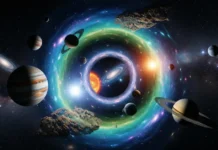

Since our school days, we have been taught that the Earth revolves around the Sun, which is why there are days and nights. However, if we delve deeper into the perspective of scientists, it becomes evident that our understanding might be oversimplified. According to NASA, the reality is that Earth does not revolve around the Sun in the manner we typically imagine. This revelation extends to the Moon as well. Let’s explore the intricate details behind this scientific truth.
Understanding the Barycenter: The Real Orbital Point
The concept that Earth revolves around the Sun is based on a simplified model. According to NASA, the Earth and other celestial bodies actually revolve around a common center of mass known as the barycenter. This point is not fixed but moves as the masses and positions of the orbiting bodies change.
The barycenter of the Earth-Sun system is usually located just outside the surface of the Sun due to the Sun’s massive size compared to Earth. The Sun’s mass is approximately 1,048 times greater than that of Jupiter, the largest planet in our solar system. The gravitational influence of massive planets like Jupiter and Saturn can shift the barycenter outside the Sun.
Kepler’s Third Law and Orbital Mechanics
Kepler’s third law helps us understand the relationship between the orbital period and the semi-major axis of an orbit. It essentially states that the square of the orbital period is directly proportional to the cube of the semi-major axis of its orbit. This law applies to any two bodies orbiting each other, regardless of their masses.
When applied to the Earth and Sun, Kepler’s law indicates that both bodies revolve around the barycenter. Given the Sun’s substantial mass, this point is near the Sun but not precisely at its center. The result is that Earth does not follow a perfect elliptical orbit around the Sun but rather an orbit around this barycenter.
The Influence of Giant Planets
Jupiter and Saturn play a crucial role in this dynamic. Their enormous masses and gravitational pulls influence the position of the barycenter. At certain times, due to their positions and gravitational effects, the barycenter can lie outside the Sun, causing Earth to orbit this point in space rather than the Sun itself.
This phenomenon is not exclusive to Earth. Other planets in our solar system also orbit around the barycenter. This shifting of the barycenter is a natural consequence of the gravitational interplay between celestial bodies of varying masses.
Implications for the Moon
The Moon, Earth’s natural satellite, experiences a similar situation. The Earth-Moon system also revolves around a barycenter, which is located inside the Earth due to Earth’s greater mass. However, this barycenter is not static; it moves within the Earth as the Moon orbits. This complex motion is crucial in understanding the true dynamics of Earth-Moon interactions.
Common Misconceptions and Educational Models
The traditional model taught in schools is simplified to aid understanding. This model places the Sun at the center with planets following perfect elliptical orbits. While this approximation is useful for basic education, it does not capture the complexities of celestial mechanics.
The actual movements of celestial bodies are governed by intricate gravitational forces and orbital mechanics. NASA emphasizes the importance of recognizing these complexities to appreciate the true nature of our solar system’s dynamics.
Revisiting Historical Models
Historically, the geocentric model proposed by Ptolemy placed Earth at the center of the universe. This model was widely accepted until the heliocentric model proposed by Copernicus gained acceptance. Copernicus suggested that the Sun was at the center, which better explained the observed planetary motions.
Today, we understand that neither model is entirely accurate. Instead, the concept of a barycenter offers a more precise explanation of orbital dynamics. This understanding reflects advancements in astronomy and space science.
Advanced Observations and Space Missions
Modern space missions and advanced telescopes provide detailed observations that support the concept of barycentric orbits. NASA’s Kepler mission, for instance, has discovered numerous exoplanets and studied their orbits, reinforcing the significance of barycenters in multi-body systems.
These observations have expanded our knowledge of orbital mechanics, not just in our solar system but also in distant star systems. Understanding barycentric motion is crucial for accurately predicting planetary positions and planning space missions.
The Bigger Picture: Cosmic Ballet
The intricate dance of celestial bodies around barycenters is a testament to the complexity and beauty of our universe. Each planet, moon, and star participates in this cosmic ballet, governed by gravitational forces and the laws of physics.
Recognizing the true nature of these orbits enhances our understanding of the universe and our place within it. It also underscores the importance of continuous exploration and study to uncover the hidden truths of celestial mechanics.
NASA ने बताया अजीब सच – सूर्य के चक्कर नहीं लगा रही पृथ्वी, चांद के साथ भी हो रहा ऐसा
स्कूल के दिनों से ही हमें सिखाया जाता रहा है कि पृथ्वी सूर्य के चारों ओर चक्कर लगाती है, इसलिए दिन और रात होते हैं। हालाँकि, अगर हम वैज्ञानिकों के दृष्टिकोण को गहराई से समझें, तो यह स्पष्ट हो जाता है कि हमारी समझ अति सरलीकृत हो सकती है। नासा के अनुसार, वास्तविकता यह है कि पृथ्वी सूर्य के चारों ओर उस तरह से चक्कर नहीं लगाती है जैसा हम आमतौर पर कल्पना करते हैं। यह रहस्योद्घाटन चंद्रमा तक भी फैला हुआ है। आइए इस वैज्ञानिक सत्य के पीछे के जटिल विवरणों का पता लगाएं।
बैरीसेंटर को समझना: वास्तविक कक्षीय बिंदु
यह अवधारणा कि पृथ्वी सूर्य के चारों ओर चक्कर लगाती है, एक सरलीकृत मॉडल पर आधारित है। नासा के अनुसार, पृथ्वी और अन्य खगोलीय पिंड वास्तव में द्रव्यमान के एक सामान्य केंद्र के चारों ओर घूमते हैं जिसे बैरीसेंटर के रूप में जाना जाता है। यह बिंदु स्थिर नहीं है, बल्कि परिक्रमा करने वाले पिंडों के द्रव्यमान और स्थिति बदलने के साथ-साथ चलता रहता है।
पृथ्वी-सूर्य प्रणाली का बैरीसेंटर आमतौर पर सूर्य की सतह के ठीक बाहर स्थित होता है क्योंकि पृथ्वी की तुलना में सूर्य का आकार बहुत बड़ा है। सूर्य का द्रव्यमान हमारे सौर मंडल के सबसे बड़े ग्रह बृहस्पति से लगभग 1,048 गुना अधिक है। बृहस्पति और शनि जैसे विशाल ग्रहों का गुरुत्वाकर्षण प्रभाव सूर्य के बाहर बैरीसेंटर को स्थानांतरित कर सकता है।
केप्लर का तीसरा नियम और कक्षीय यांत्रिकी
केप्लर का तीसरा नियम हमें कक्षीय अवधि और किसी कक्षा की अर्ध-प्रमुख धुरी के बीच के संबंध को समझने में मदद करता है। यह अनिवार्य रूप से बताता है कि कक्षीय अवधि का वर्ग इसकी कक्षा की अर्ध-प्रमुख धुरी के घन के सीधे आनुपातिक है। यह नियम एक दूसरे की परिक्रमा करने वाले किसी भी दो पिंडों पर लागू होता है, चाहे उनका द्रव्यमान कुछ भी हो।
जब पृथ्वी और सूर्य पर लागू किया जाता है, तो केप्लर का नियम इंगित करता है कि दोनों पिंड बैरीसेंटर के चारों ओर घूमते हैं। सूर्य के पर्याप्त द्रव्यमान को देखते हुए, यह बिंदु सूर्य के पास है लेकिन ठीक उसके केंद्र पर नहीं है। इसका परिणाम यह है कि पृथ्वी सूर्य के चारों ओर एक पूर्ण अण्डाकार कक्षा का अनुसरण नहीं करती है, बल्कि इस बैरीसेंटर के चारों ओर एक कक्षा का अनुसरण करती है।
विशाल ग्रहों का प्रभाव
बृहस्पति और शनि इस गतिशीलता में महत्वपूर्ण भूमिका निभाते हैं। उनके विशाल द्रव्यमान और गुरुत्वाकर्षण खिंचाव बैरीसेंटर की स्थिति को प्रभावित करते हैं। कुछ समय में, उनकी स्थिति और गुरुत्वाकर्षण प्रभावों के कारण, बैरीसेंटर सूर्य के बाहर स्थित हो सकता है, जिससे पृथ्वी सूर्य के बजाय अंतरिक्ष में इस बिंदु की परिक्रमा करती है।
यह घटना केवल पृथ्वी तक ही सीमित नहीं है। हमारे सौर मंडल के अन्य ग्रह भी बैरीसेंटर के चारों ओर परिक्रमा करते हैं। बैरीसेंटर का यह स्थानांतरण अलग-अलग द्रव्यमान वाले खगोलीय पिंडों के बीच गुरुत्वाकर्षण परस्पर क्रिया का एक स्वाभाविक परिणाम है।
चंद्रमा के लिए निहितार्थ
पृथ्वी का प्राकृतिक उपग्रह चंद्रमा भी इसी तरह की स्थिति का अनुभव करता है। पृथ्वी-चंद्रमा प्रणाली भी एक बैरीसेंटर के चारों ओर घूमती है, जो पृथ्वी के अधिक द्रव्यमान के कारण पृथ्वी के अंदर स्थित है। हालाँकि, यह बैरीसेंटर स्थिर नहीं है; यह चंद्रमा की परिक्रमा के साथ पृथ्वी के भीतर घूमता है। यह जटिल गति पृथ्वी-चंद्रमा की अंतःक्रियाओं की वास्तविक गतिशीलता को समझने में महत्वपूर्ण है।
आम गलतफहमियाँ और शैक्षिक मॉडल
स्कूलों में पढ़ाए जाने वाले पारंपरिक मॉडल को समझने में सहायता के लिए सरल बनाया गया है। यह मॉडल सूर्य को केंद्र में रखता है और ग्रह पूर्ण अण्डाकार कक्षाओं का अनुसरण करते हैं। जबकि यह अनुमान बुनियादी शिक्षा के लिए उपयोगी है, यह खगोलीय यांत्रिकी की जटिलताओं को नहीं दर्शाता है।
आकाशीय पिंडों की वास्तविक गति जटिल गुरुत्वाकर्षण बलों और कक्षीय यांत्रिकी द्वारा नियंत्रित होती है। नासा हमारे सौर मंडल की गतिशीलता की वास्तविक प्रकृति की सराहना करने के लिए इन जटिलताओं को पहचानने के महत्व पर जोर देता है।
ऐतिहासिक मॉडलों पर फिर से विचार करना
ऐतिहासिक रूप से, टॉलेमी द्वारा प्रस्तावित भू-केन्द्रित मॉडल ने पृथ्वी को ब्रह्मांड के केंद्र में रखा। यह मॉडल व्यापक रूप से स्वीकार किया गया जब तक कि कोपरनिकस द्वारा प्रस्तावित सूर्यकेन्द्रित मॉडल को स्वीकृति नहीं मिली। कोपरनिकस ने सुझाव दिया कि सूर्य केंद्र में था, जिसने देखे गए ग्रहों की गति को बेहतर ढंग से समझाया।
आज, हम समझते हैं कि कोई भी मॉडल पूरी तरह से सटीक नहीं है। इसके बजाय, बैरीसेंटर की अवधारणा कक्षीय गतिशीलता की अधिक सटीक व्याख्या प्रदान करती है। यह समझ खगोल विज्ञान और अंतरिक्ष विज्ञान में प्रगति को दर्शाती है।
उन्नत अवलोकन और अंतरिक्ष मिशन
आधुनिक अंतरिक्ष मिशन और उन्नत दूरबीन विस्तृत अवलोकन प्रदान करते हैं जो बैरीसेंट्रिक कक्षाओं की अवधारणा का समर्थन करते हैं। उदाहरण के लिए, नासा के केपलर मिशन ने कई एक्सोप्लैनेट की खोज की है और उनकी कक्षाओं का अध्ययन किया है, जिससे मल्टी-बॉडी सिस्टम में बैरीसेंटर के महत्व को बल मिला है।
इन अवलोकनों ने न केवल हमारे सौर मंडल में बल्कि दूर के तारा प्रणालियों में भी कक्षीय यांत्रिकी के बारे में हमारे ज्ञान का विस्तार किया है। ग्रहों की स्थिति का सटीक अनुमान लगाने और अंतरिक्ष मिशन की योजना बनाने के लिए बैरीसेंट्रिक गति को समझना महत्वपूर्ण है।
Discover more from RitzyTimes
Subscribe to get the latest posts sent to your email.